For centuries, Kraków Gate has stood at the edge of Lublin's historic centre, witnessing the city grow, burn, change and rebuild.
There are places where the history of a city is written into the buildings themselves. In Lublin, Kraków Gate is one of them.
Today, the historic gateway is home to the History of Lublin City Museum, giving visitors an opportunity to explore the city's past from inside a structure that has been part of its story for centuries. The relationship between building and museum is particularly fitting. Kraków Gate has experienced many of the changes that have shaped Lublin, from medieval expansion and destructive fire to wartime damage and post-war restoration.
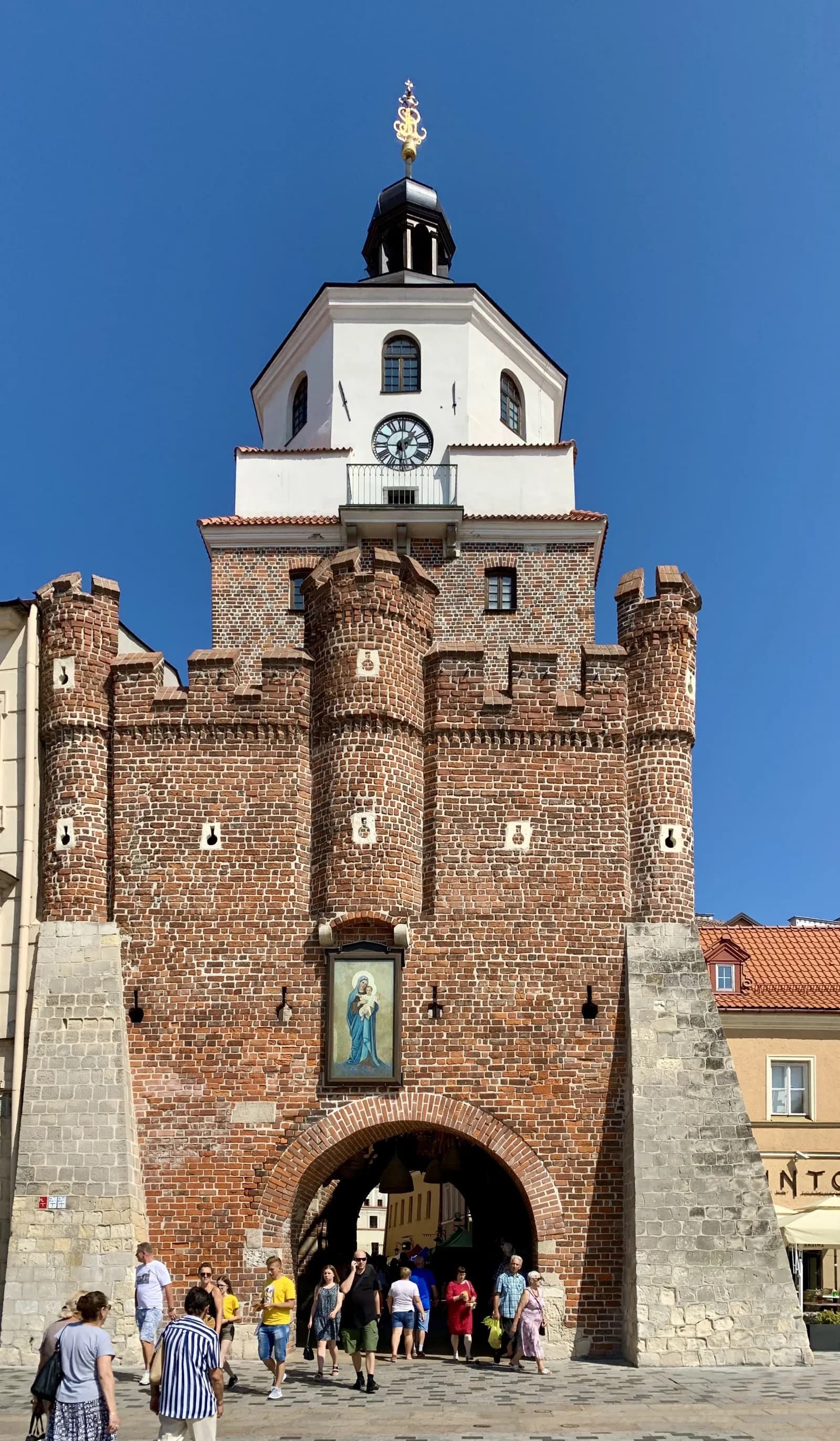
The gate was built under Kazimierz the Great following the Tatar invasion of 1341. It formed one of two gates incorporated into Lublin's defensive walls, marking an important entrance to the city. Over the centuries, the structure continued to evolve. A foregate was added from the middle of the sixteenth century, while additional storeys were constructed on the tower until the eighteenth century.
The result is a building whose appearance reflects more than one period of Lublin's history.
A medieval gateway shaped by centuries of change
Kraków Gate did not simply survive alongside the city. It repeatedly shared its fortunes.
One of the most dramatic moments came in 1575, when a fire consumed almost all of Lublin and also destroyed the gate. Its subsequent repairs became part of the long process through which the structure was repeatedly adapted to the needs and character of the city around it.
During the period of the Bonis Ordinis Commission, the building underwent another major renovation. The octagonal storey was given a Baroque tented roof, finished with the royal monogram SAR, referring to Stanislaus Augustus Rex. The date 1782 was also incorporated into the renovation.
These changes reveal how Kraków Gate accumulated layers of history rather than remaining frozen in its medieval form. Its architecture became a record of successive periods, with later generations leaving their own mark on a structure inherited from the Middle Ages.
The gate also acquired a more personal and devotional character during the nineteenth century. At the beginning of the century, a painting of the Holy Mother was placed on the side facing Krakowskie Przedmieście. In 1839, a painting of St Anthony of Padua was added on the side facing the Old Town.
For a structure designed originally as part of Lublin's defences, these additions demonstrate how its role and meaning had evolved over time.
From surviving monument to museum
The twentieth century brought another difficult chapter. Kraków Gate suffered significant damage during the Second World War, once again placing its survival in question.
Restoration and conservation work began in 1959. During this process, the stone and brick architectural decoration was uncovered, helping to reveal elements of the building that had been obscured over time. The interiors were subsequently adapted for museum purposes.
That transformation created a new role for Kraków Gate without severing its connection to the past. From 1965, it housed the Historical Branch of the Lublin Museum. In 1979, the building became the permanent home of the History of Lublin City Museum.
The decision to place a museum devoted to Lublin's history inside one of the city's historic gates gives the institution a particular character. The building itself provides an immediate connection to the subject being explored.
Visitors do not simply arrive at a modern museum and then encounter a historical city through objects and displays. They enter through a structure that was once part of Lublin's defensive system and has survived fires, reconstruction, changing architectural fashions and war.
History encountered at the city gate
The significance of the museum therefore extends beyond the collections it presents. Kraków Gate offers a physical starting point for understanding Lublin's historic centre and the layers of change that have shaped it.
Its position is important, too. The gate stands at a point where the historic city meets Krakowskie Przedmieście, connecting different parts of Lublin while retaining its identity as a remnant of the medieval defensive system.
For visitors, that makes the museum particularly useful as an introduction to the city. The story begins not with an abstract date or distant historical figure, but with the building itself.
Kraków Gate has been rebuilt and adapted many times, yet its continued presence provides a sense of continuity. The same structure that once controlled movement through Lublin's walls now welcomes people interested in understanding the city it helped protect.
That is what makes the History of Lublin City Museum especially appropriate to its setting. The museum tells the history of Lublin from inside a monument that has been living through that history for almost seven centuries. Rather than simply preserving the past, Kraków Gate demonstrates how a city can carry its earlier lives forward, layer by layer, into the present.
Visitor Information
History of Lublin City Museum
Kraków Gate, Lublin
Location: Historic Kraków Gate in the centre of Lublin.
Admission:
Regular ticket: PLN 10
Reduced ticket: PLN 8