Lublin is one of Poland’s oldest and most historically significant cities. Located in eastern Poland, it has spent centuries at the crossroads of European trade routes, political developments and cultural influences.
From its early medieval settlements to its role in creating the Polish–Lithuanian Commonwealth, Lublin has been a place where different communities, ideas and traditions have met. Today, the city combines historic heritage with a strong academic, cultural and economic identity.
Early Settlements Along the Bystrzyca River
The origins of Lublin reach back to the early medieval period. Archaeological research indicates Slavic settlement activity in the area from around the 6th and 7th centuries, including on Czwartek Hill, where traces of early communities have been discovered.
The exact development of the earliest settlement is still studied by historians and archaeologists, as evidence from this period is limited. However, Lublin’s favourable location helped it grow into an important regional centre.
The city’s first written mention dates from 1198, confirming its established role within medieval Poland.
The Growth of a Medieval Trading Centre
A major milestone in Lublin’s development came in 1317, when King Władysław Łokietek granted the city Magdeburg rights.
This royal charter provided Lublin with important urban privileges, supporting the growth of local administration, commerce and settlement.
By the 14th century, Lublin had become an important trading centre. Its location along routes connecting western Europe with the eastern regions of the continent helped attract merchants and strengthen its economic importance.
Trade links with the Grand Duchy of Lithuania further increased the city’s influence, allowing Lublin to become one of the key commercial centres of Central and Eastern Europe.
The Union of Lublin: A Landmark in European History
Lublin’s most internationally recognised historical event took place in 1569 with the signing of the Union of Lublin.
The agreement united the Kingdom of Poland and the Grand Duchy of Lithuania, creating the Polish–Lithuanian Commonwealth, one of the largest political states in Europe at the time.
Lublin was chosen as the meeting place because of its position between the two territories. The city became associated with the political ideas of cooperation and shared governance that shaped the new Commonwealth.
Because of this role, historians sometimes describe Lublin as an “ideological capital” of the Commonwealth, reflecting its importance as a place where the union between Poland and Lithuania was negotiated and established.
A Centre of Law and Political Life
In 1578, Lublin gained further importance when it became the seat of the Crown Tribunal, the highest appeal court of the Polish–Lithuanian Commonwealth.
For more than two centuries, the city served as an important centre of justice, administration and political activity. The local nobility participated in royal elections, and Lublin maintained a privileged position within the Commonwealth until the Partitions of Poland in the late 18th century.
This period left a lasting mark on the city’s architecture, traditions and cultural identity.
Lublin in the 20th Century
The 20th century brought dramatic changes to Lublin and the surrounding region.
During the Second World War, the city experienced German occupation and became the site of the Majdanek concentration camp, established by Nazi Germany. Today, the Majdanek State Museum preserves the memory of the victims and serves as an important place of education and remembrance.
In 1944, as the Second World War was coming to an end, Lublin became the headquarters of the Polish Committee of National Liberation (PKWN). For several months, it served as the centre of the emerging post-war Polish administration before state authorities moved to Warsaw in 1945.
Education, Industry and Modern Identity
Today, Lublin is the capital of the Lublin Voivodeship and one of eastern Poland’s leading cultural, educational and economic centres.
The city has a diverse economy, including industries such as:
agricultural machinery production
chemical manufacturing
automotive production
food processing
brewing
Lublin is also an important academic centre. The Catholic University of Lublin, founded in 1918, remains one of the city’s most significant educational institutions.
Universities, museums and cultural organisations continue to strengthen Lublin’s role as a centre for research, heritage and public life.
Preserving Lublin’s Heritage
Lublin’s identity is closely connected with preserving and sharing its complex history.
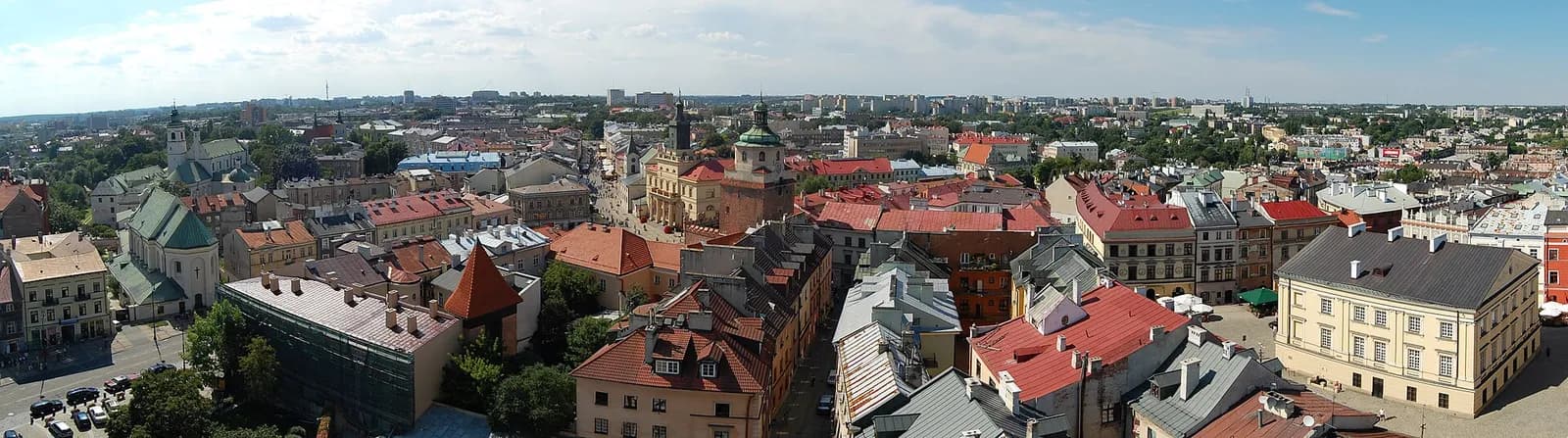
The Old Town, Lublin Castle and historic landmarks reflect the city’s medieval and political importance. Meanwhile, cultural programmes, historical research and educational projects continue to explore the many communities and traditions that have shaped Lublin over the centuries.
The city’s heritage reflects its long-standing role as a meeting point between East and West, connecting Poland’s history with wider European developments.
Lublin Today: A City Looking Forward
Modern Lublin combines historic character with contemporary energy. Its universities, cultural institutions and growing economy contribute to a city that continues to evolve while respecting its past.
For visitors and residents alike, Lublin offers a unique perspective on Poland’s history, from medieval trade and royal politics to modern cultural life.
Lublin’s history is a story of connection. Its location, traditions and historic events have made it one of Poland’s most important cities.
From early settlements on Czwartek Hill to the Union of Lublin and its modern role as a cultural centre, Lublin continues to represent the meeting of different cultures, ideas and generations.