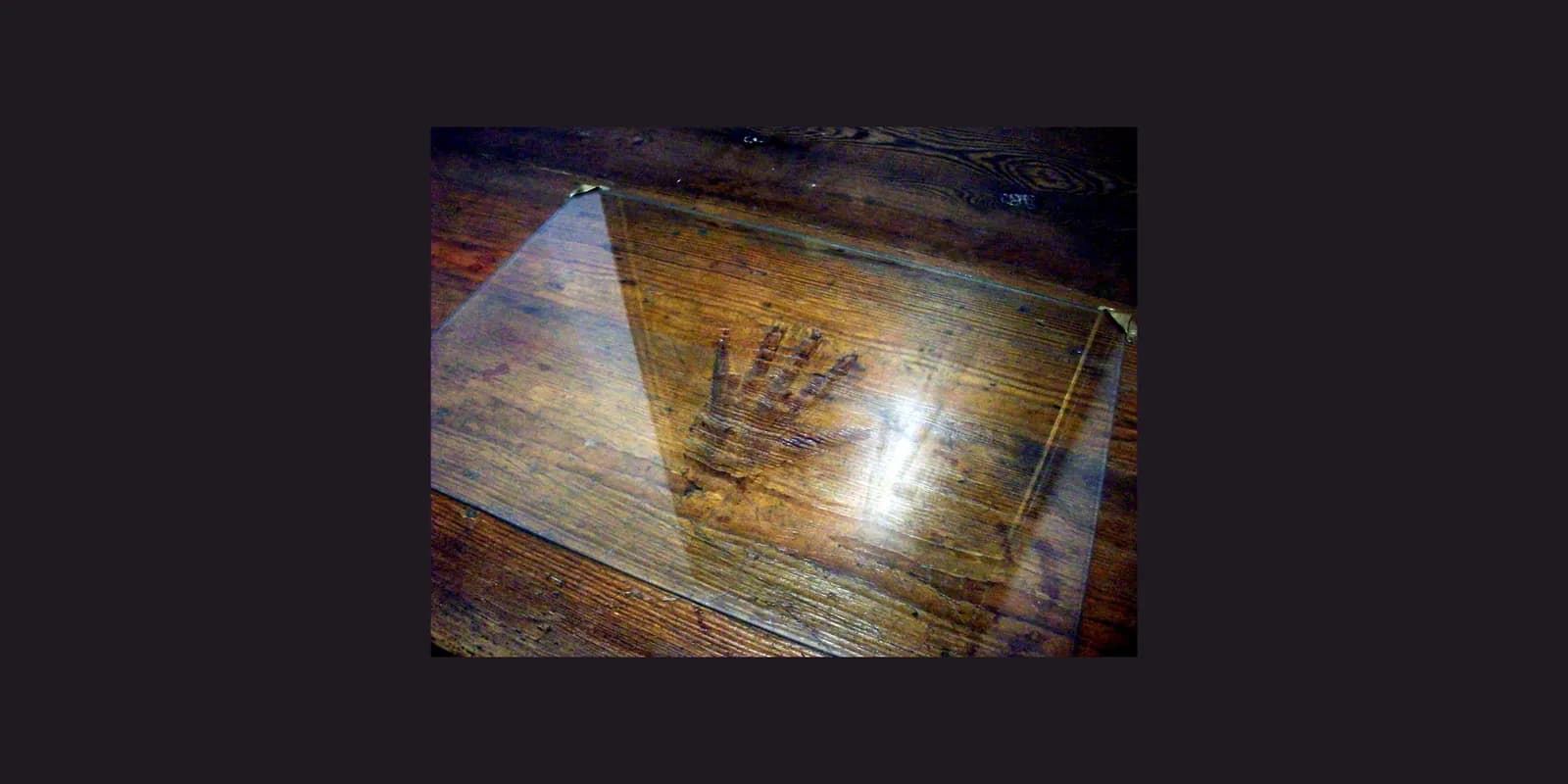
Walk through Lublin’s Old Town and sooner or later you will come across the story of Czarcia Łapa, the Devil’s Paw. It is one of the city's best-known legends, centred on the former Crown Tribunal and a mysterious handprint burned into an old wooden table.
The story has all the ingredients of a classic Lublin tale: an apparently corrupt court, a wronged widow, a midnight gathering and a group of judges who turn out not to be quite what they seem.
But behind the familiar story is a more complicated history. The table is real, the Crown Tribunal was real, and there are historical references to stories of supernatural judges. The precise events described in the legend, however, are much harder to establish.
The Crown Tribunal in Lublin
The story begins at the Trybunał Koronny, the imposing building in the middle of Lublin’s Rynek.
Established in 1578, the Crown Tribunal became the highest court of appeal for the nobility of Lesser Poland and the eastern parts of the Polish-Lithuanian Commonwealth. Its presence made Lublin an important centre of political and legal life.
It also gave the city the perfect setting for a story about justice going badly wrong.
Over the years, the Tribunal acquired a reputation for corruption and bribery. Whether every accusation was justified is another question, but the perception became part of the institution's later image. The building eventually became inseparable from stories about judges, money and questionable verdicts.
And one particular story proved especially memorable.
A widow asks for justice
According to the best-known version of the legend, a poor widow became involved in a legal dispute with a wealthy and influential nobleman.
The case went before the Crown Tribunal. The widow expected justice, but the judges were supposedly persuaded by the other side's money and influence.
The verdict went against her.
Desperate and furious, the widow is said to have appealed to God, crying out that even the devil would give a fairer judgement.
That night, something strange happened in the Tribunal.
A group of unfamiliar judges appeared after dark. They seemed at first to be ordinary members of the nobility, but there was something unsettling about them. Eventually, the court clerk realised that these were not human judges at all.
They were devils.
The supernatural court reconsidered the widow's case and reached a different verdict, this time in her favour.
One of the devil-judges then placed his hand on the courtroom table.
When he lifted it, a dark, burnt impression remained in the wood.
The handprint that visitors can still see
This is where the legend becomes tangible.
The famous table survives and is now displayed at Muzeum Narodowe w Lublinie, inside Lublin Castle. The hand-shaped mark remains its most striking feature.
The museum treats the object as part of the history and folklore surrounding the Crown Tribunal, describing the table as an object surrounded by legend. There is good reason to be cautious, however. The existence of the table and the mark does not establish the supernatural story that grew around them.
Even the table's precise history has been questioned by researchers.
The National Archives catalogue gives the table an earlier date, while later research has raised questions about its provenance and its exact connection with the Crown Tribunal.
In other words, the table is real, but the devil's involvement remains firmly in the realm of legend.
What about 1637?
The traditional story usually places the devil's trial in 1637.
There is an intriguing reason that date has persisted.
Historical research has uncovered a seventeenth-century account referring to a strange night-time event connected with the Crown Tribunal in Piotrków Trybunalski. The account describes mysterious figures associated with judging at night.
It does not, however, prove that devils actually sat in judgement, nor does it provide evidence for the Lublin widow's story.
Piotrków is significant because it was also a seat of the Crown Tribunal. Similar stories about supernatural judges therefore developed around more than one Tribunal city.
This suggests that the Lublin legend may have grown from a mixture of real memories, oral storytelling and later additions rather than from one documented event.
The story's most striking detail
There is another part of the legend that is easy to miss.
The courtroom supposedly contained a crucifix. After witnessing the devils deliver a fairer verdict than the human judges, Christ is said to have cried tears of blood and turned His face away from the court.
It is a powerful image.
The point is not really that the devil was good. It is that the human judges had fallen so far short of justice that even the devil could supposedly do better.
That gives Czarcia Łapa its particular character. It is frightening, but it is also satirical.
The devil becomes an unlikely symbol of justice, while the human court becomes the object of criticism.
The crucifix is still in Lublin
The story did not remain confined to the Tribunal.
The crucifix associated with the legend is now kept in Lublin Cathedral, giving the tale another physical location in the Old Town.
Together with the former Tribunal and the Czarcia Łapa table at Lublin Castle, it creates an unusual trail through the city.
A visitor can encounter the three main elements of the story in different places around central Lublin, each with its own documented history.
When did Czarcia Łapa become a legend?
This is one of the most interesting questions surrounding the story.
It is tempting to imagine that the tale has been passed down unchanged since 1637. Historical research suggests otherwise.
The story appears to have developed gradually, with details being added and reshaped over time. Researchers have questioned how far the familiar version can actually be traced back to the seventeenth century.
The famous handprint itself only appears clearly in later descriptions. Research has pointed to 1876 as an important early documentary reference to the mark.
That is a considerable gap from the traditional date of 1637.
It does not mean that people in earlier centuries had no stories about strange happenings at the Tribunal. It means that we should be careful about treating today's version as a verbatim account of something that happened almost four centuries ago.
A legend built around a very real fear
Perhaps that is why Czarcia Łapa has survived so well.
The story touches on a fear that is hardly confined to seventeenth-century Lublin: that justice can be influenced by wealth, status and connections.
The widow has little power. The nobleman has plenty.
The judges are supposed to uphold the law, yet the legend portrays them as willing to abandon it.
Then the impossible happens. The devil arrives and, remarkably, puts things right.
The burnt handprint becomes a permanent reminder of the joke at the heart of the story: when human justice fails, perhaps only the devil can put it right.
A devil's paw, a city's memory
Czarcia Łapa has changed considerably since the story first began circulating. Some details are difficult to document, others appear to have been added much later, and the exact history of the famous table remains the subject of research.
But the essential story has stayed remarkably effective.
A poor woman asks for justice. A powerful man gets his way. A supernatural court intervenes. A hand is burned into a table.
Four centuries later, the mark remains in Lublin, and the story is still being told.
See more: A Historic Crossroads of East and West in Poland's Heartland
Sources: Wikipedia, Teatr NN, lublin.eu
Image credit: Merete25, Wikimedia Commons, CC BY-SA 4.0,